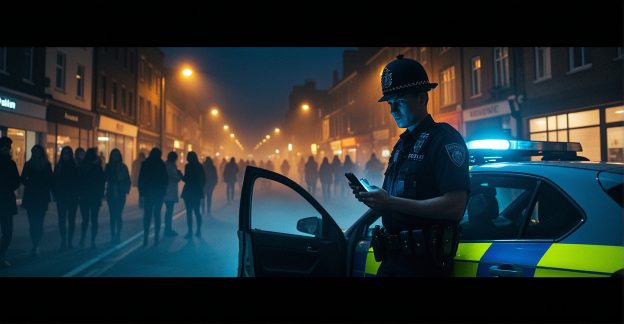
Because apparently swearing an oath to “act with honesty and integrity” is optional in modern British policing
Just when you thought the sex scandal at the heart of British policing couldn’t get any more tawdry, along comes another officer with his trousers round his ankles and his phone in his hand.
Anthony Spelman — known to colleagues as Tony — has been formally sacked from Cheshire Police after a misconduct panel concluded that he had, in effect, been treating his shift as a dating app with a warrant card attached.
The former police constable was dismissed for gross misconduct after it emerged he had:
- Exchanged up to 90 “highly sexualised” messages a day with 12 different women while supposedly on duty
- Accessed pornography on his personal mobile during shifts
- Confided his desire for “rape role-playing” to a woman he was texting mid-shift
- “Pursued” a woman whose son he had previously arrested — clocking her on a dating site, then sending her sexual messages and meeting up with her
The messages, sent and received between April and September 2023, were described in the misconduct report as revealing a “preoccupation with your own sexual matters in the workplace.”
Which is a wonderfully diplomatic way of saying: while the public of Cheshire waited for a copper, the copper was busy sexting.
Chief Constable Mark Roberts concluded in the report that Spelman’s behaviour amounted to “abusing his position as a police officer for a sexual purpose.”
Chief Constable Mike Evans, also of Cheshire Police, offered the now-standard corporate lament: officers swear an oath, Spelman “ignored these core guidelines,” he “thought he could act in such an unacceptable way without consequence — he was wrong.” Spelman was dismissed without notice and barred from re-entering the profession.
The misconduct hearing itself was held behind closed doors on 28 April. Because of course it was.
The Pattern Is the Point
Spelman’s catalogue of carnality would be a footnote were it not for the fact that it is so utterly, grindingly familiar.
Wayne Couzens. A serving Metropolitan Police officer who kidnapped Sarah Everard from a South London street in March 2021, raped her, and burned her body in a Kent woodland. He had been a flashing, indecent-exposure merchant for years before anyone in the Met bothered to notice.
David Carrick. A Met armed officer and former soldier who pleaded guilty to 49 offences against 12 women spanning nearly two decades — including multiple rapes — and was handed a whole-life sentence in February 2023. He was, by the Met’s own reckoning, a serial rapist in uniform who kept his job because nobody joined the dots.
These two are the summit of the mountain. But the mountain is enormous.
For those keeping score at home: Thames Valley Police alone has sacked 53 officers or staff for proven sexual misconduct since 2020. Greater Manchester Police had five officers accused of sexual misconduct dismissed in a single year. Essex has binned a senior officer for sexual behaviour without consent. Yorkshire has sacked five officers whose names the public will never even learn. Sussex is issuing press releases promising that “misogyny and sexual misconduct have no place” in its ranks — which raises the obvious question of how they keep finding room for it.
So What’s Actually Wrong?
Here’s the uncomfortable thesis, and it’s not one that the forces like to confront:
Policing recruits, trains and promotes men on a set of standards it then refuses to enforce. The oath is sworn. The “code of ethics” is recited. And then a bloke spends four years texting a dozen women about rape fantasies from the front seat of a marked car, and everyone acts surprised when a hearing finally catches up with him.
The second problem is accountability theatre. Behind-closed-doors hearings. Officers referred to as “Officer A” so the public can’t follow the case. Gross misconduct findings that arrive years after the behaviour. Speedy, decisive-sounding statements from chief constables after the panel has ruled — never before.
The third problem is the one that genuinely stings: the public is required to trust these people under caution. When you’re arrested, when you’re questioned, when you’re in the back of a van, when you’re a vulnerable woman giving a statement — you are asked to believe that the person across from you is a cut above. Cases like Spelman’s, Couzens’s and Carrick’s make that ask considerably harder.
The Bottom Line
Spelman is not a monster. He didn’t murder anyone. He didn’t rack up 49 offences. He was, by the standards of his own force, a fairly ordinary officer who just happened to conduct his love life from the driver’s seat of a patrol car with the radio crackling in the background.
And that’s precisely why he matters. Because if this is what an ordinary copper gets up to, then the extraordinary ones — the Couzenses, the Carricks — were never the aberrations everyone insists they are.
They were the far end of a spectrum. And the spectrum starts somewhere.
Somewhere a lot closer to Tony Spelman.
Reporting drawn from the Daily Mail, Liverpool Echo and Manchester Evening News. Spelman was dismissed earlier this year and added to the barred list.